Wow, I really fell off the writing wagon for awhile. I got busy with freelance design projects and just did not have time to write. It simply was not essential at a time when I was working literally every one of my waking and my children's non-waking moments. (I just read--well, listened--to the book Essentialism by Greg McKeown, which was absolutely fabulous and I hope to write an entire post on it soon.)
But things are settling down as far as design projects go, so I plan to get back to writing a post a week.
In the meantime, you can check out one of the projects that took me away from writing. I did the layout for the May/June issue of the Desert Shamrock, which you can view online or pickup a copy at the Irish Cultural Center or many other locations around Arizona--visit desertshamrock.com for details. It was my first newspaper project since my newspaper design class at ASU the summer of 2004 (or was it 2003? Man, time flies!). I learned a lot from the project and am thankful I got the opportunity!
It was a lot of work but also a lot of fun, and I am very grateful to my family for making it possible. Without their babysitting help or my husband and kids enduring a messy house and lousy food for a couple of weeks, I wouldn't have been able to tackle this project.
I am very blessed with a husband who supports my personal and career development. While I am more and more confident each day in my decision to be a stay at home mom during this season of life, I know from my mom's experience how important it is to have marketable skills.
My mom stayed at home during my first 18 years of life. She had stepped down from her position as a nursing instructor at the University of Iowa to raise us three kids. When my parents decided to homeschool, her stay-at-home role was cemented. She wouldn't be re-entering the workforce when we all entered school as many moms do.
I never heard her utter a complaint about her role, and her career seemed irrevocably behind her. Until the day my dad became disabled and suddenly she had to go back to work.
She took a refresher course at a community college to get her nursing license renewed, and went back to work at the hospital. Her college education and dedication to her early career really paid off decades later!
Her influence was obvious when I chose to study graphic design in college. "This is something I could do at home when I have kids," I thought...even though at the time I didn't want to be a stay at home mom. I guess I wanted to keep my options open.
And now, here I am 14 or so years later, using the skills I learned in college to bring home some (itty-bitty) bacon while staying at home with my kids. My goal is to keep my skills sharp so that, if and when I do need to reenter the full-time workforce, I am ready.
So my advice to any girls out there who plan to be stay at home moms and are debating whether to go to college/trade school...do it! Yes, being a stay at home mom is awesome and very important, and yeah maybe you won't ever use your degree/certificate...but it is far more likely that you will need it someday. And you can learn skills that you can use while being stay at home mom. Remember, there will be life after kids...will you be ready for it?
I for one and very thankful for the excellent example God gave me in my mom! I love you, Mom! Happy Mother's Day!
Saturday, May 9, 2015

Thursday, April 2, 2015
A New Appetite for Non-Fiction
It's April! That means the first quarter of 2015 is over. I'm not even going to get into how crazy fast time is flying by. I could go on and on about that, and that is not the point of today's post.
If you remember, I made a bunch of New Year's Resolutions for 2015. I decided to review them on a quarterly basis, to increase the likelihood that I will actually follow through on them.
Looking through my list, I'm pretty encouraged. So far I am at least making some progress towards about two thirds of my resolutions. Since many of them involved changes to my daily/weekly routine, I think that's pretty good! There is definitely still a lot to be done, but I am learning to focus on what is getting done rather than what is not (wisdom from a former boss).
It is very encouraging to see change in one's life, even in small things. For example, one of my resolutions may not seem like a big deal on the surface, but keeping it has reflected a huge shift in my priorities, appetites, and thinking.
As I have mentioned before, I love reading. I enjoy a wide variety of genres, but mostly fiction. Last year I read 1 nonfiction book for about every 3 fiction books. Wanting to enrich myself more and entertain myself less, this year I resolved to read 1 nonfiction book for every 2 fiction books.
Would you believe that in the first three months of this year I have gone beyond my goal and read 2 nonfiction books for every 1 fiction book?
And not because I had to. Because I wanted to.
God is changing my appetite for books.
Wow!
I think it started with my trip to Germany last fall. It really got me interested in German and European history, so I read several books on the subject which, interestingly enough, has really enhanced my appreciation for my spiritual heritage as a dispensational Baptist. Seeing the damage inflicted on Europe--Germany in particular--because of a different interpretation of the Bible was very eye opening. Whether or not the church has replaced Israel, or is merely a parenthesis within God's larger plan for the Jews, is not merely a dry theological disagreement. Just ask the Europeans who killed and were killed because people thought the church and state should be combined in a theocracy like ancient Israel. Ask the Jews who have been persecuted in the name of Christ by people who thought the church had replaced an Israel which God had forever rejected and cast aside.
But I digress. After reading about German history and a little about how Baptists helped get the Bill of Rights--particularly the First Amendment--added to the U.S. Constitution, I read Barack Obama's Dreams from My Father. Whether or not I voted for him, he is my president, so I wanted to understand his perspective a little better. Then I read a book by an opponent.
It's very educational to read books coming from both sides of an issue!
Which is exactly what I did when I started reading on the subject of whether or not Pluto is a planet. I got onto this seemingly random topic in a seemingly random way--after finishing one audiobook from the digital library, I browsed the non-fiction section to see what was available, and the title How I Killed Pluto and Why It had it Coming jumped out at me. I mean, really, that book is just begging to be read!
I could not put down (or, rather, turn off) this book. I've always been a science lover (I almost majored in chemistry) and a lover of the stars (yes, I did dream of being an astronaut--who hasn't?), so the book intrigued me on that level. I was fascinated by the descriptions of astronomical work (though honestly it sounds pretty tedious and boring), intrigued by the historical accounts of how the planets were discovered (particularly the asteroids which did not end up retaining planet status), and learned a lot about the solar system and how the science of astronomy works today.
It was also the deeply personal story of Mike Brown, the scientist who discovered Eris, the object larger than Pluto that finally forced the scientific community to define the word planet for the first time, an action which demoted Pluto and Eris to dwarf planet status. (By the way, according to the official IAU definition, a dwarf planet is not a planet).
Brown's book weaves the stories of how he met his wife and became a father in with the stories of his discoveries. This interweaving is quite relevant as he discovered Eris while his wife was pregnant with their first child, and was forced to announce the discovery when she was just weeks old. He included a lot of his thoughts about his daughter, and about being a father. I learned a lot from reading the book, and felt like I really got to know him (and his wife Diane and his daughter Lila). I loved how he kept detailed notes about Lila's first months and posted them online, complete with graphs and statistics. It was eerily similar to what I did with both of my sons, except I didn't post my graphs online.
This was my favorite quote from the book about Lila, as it perfectly describes the wonder every parent has as they watch their children grow:
 |
| My husband and I at Wartburg Castle in Germany, where Martin Luther translated the New Testament into German-- and where an Anabaptist pastor was imprisoned for his beliefs. |
Diane and I often joke about parents who think that everything their children do is exceptional. ... Watching Lila develop, I finally understood--she is exceptional, because early childhood development is about the most exceptional thing that takes place in the universe. Stars, planets, galaxies, quasars, are all incredible and fascinating things.... But none of them is as thoroughly astounding as the development of thought, the development of language. Who would not believe that their child is exceptional? All children are--compared to the remainder of the silent universe around them. ... In our own house, the most extraordinary thing in the universe was taking place.
Of course this is mainly a book about planets. Brown is very adamant that Pluto does not deserve planet status. Before reading this book, I didn't think it was a very big deal one way or the other. I remember just being annoyed that scientists had changed things on us. But Brown says:
The debate about whether or not Pluto is a planet is critical to our understanding of the solar system. It is not semantics, it is fundamental classification. If you think of the solar system as a place consisting of eight planets, or, better, four terrestrial planets and four giant planets, and then a swarm of asteroids and a swarm of Kuiper Belt objects, you have a profound description of the local universe around us. ... If, on the other hand, you think of the solar system as a place with large things that are round and smaller things that are not quite round, you have a relatively trivial description of the universe around us.
After reading his book, he had me convinced. I better understood the historical context, and better understood the solar system. But then, of course, I had to read a book from the other perspective. So I picked up The Case for Pluto: How a Little Planet Made a Big Difference from the library. (I love libraries!!)
On a deeper level, it's a case study that shows how politics and personalities can affect the scientific process, and how the scientific process can in turn affect popular culture....Ultimately it's up to the scientific community and the general public to decide how planets will be classified. Sometimes these two constituencies will go in different directions. For example, ask a botanist whether tomatoes, corn, and green beans are vegetables. Then go ask a cook.

Sunday, March 22, 2015
Easy vs. Best
I love having conversations with my four-year-old. I always learn so much.
Take Monday, for example. The boys and I went to my parents' house for an early dinner with relatives I hadn't seen in years. I rushed around helping Mom get food on the table while feeding the baby and trying to maintain a conversation with the relatives. Meanwhile, my oldest son was happily playing with his cousin.
I should have made him sit down and eat, too. But I was busy, and he was happy, and I decided to take the easy road and avoid a battle over food and loss of play time. I decided to feed him later.
Next thing I knew, he and his cousin were eating cake! I should have stopped him right then, and made him sit down and eat dinner instead. But I was busy, and he was happy, and I decided to take the easy road and avoid a battle over food and loss of play time. I decided to feed him later, at home.
I'm sure you parents out there can see exactly where this is going. If I had stopped and thought about it for two seconds I would've seen it, too. But I was enjoying the rare privilege of adult conversation, and suddenly it was almost bedtime and we still had a 20 minute drive ahead of us.
And that's when it happened.
The Meltdown.
It started when my son and his cousin decided to have a race to decide who could eat the last ring pop. (Did I mention that they'd had candy in the midst of all this, too?) Of course my son, being younger and shorter, lost.
He did not take it well.
He stood there wailing and inconsolable. I tried everything I could think of to calm him down, but he could not calm down. I could see panic in his eyes--he wanted to calm down, but didn't know how to handle the way he felt. It was seriously the worst meltdown he has ever had in his entire life.
And of course he had it in front of relatives I hadn't seen since before college. How embarrassing.
A wave of guilt tempered my frustration at his behavior as I realized that it was rooted in my earlier "easy" choices. This poor kid, who had never missed a meal in his life, had skipped dinner and loaded up on sugar. The meltdown was inevitable, as was the stomachache that quickly followed.
Duh.
I felt like such a bad mom as I tried (mostly unsuccessfully) to calm him down enough to get him out the door and in the car so I could get him home and get some real food into him.
Our conversation on the way home went something like this:
SON (sniffling): Why does my tummy hurt so bad?
ME: Because you didn't eat your dinner, so you didn't have any good food, and then you ate a lot of sugar.
SON (accusingly): Why didn't you give me dinner, Mommy?
ME: I was trying to be nice. You were having so much fun playing with your cousin. I didn't think you'd want to stop playing to eat dinner.
SON (getting more upset): But now my tummy huuuuuuurts!! Why didn't you make me eat any good food?
ME: Because it would've been harder to make you stop playing and eat. I chose what was easier. And I was wrong, I'm so sorry. I think we both learned a lesson from this.
SON (skeptical): What?
ME: I learned that the easy choice is not always the best choice. And you learned that eating too much sugar makes you feel bad.
SON (after a pause): Mommy, why didn't you make me eat dinner?
Our conversation continued along those lines even after we got home. It always came back to, "Why didn't you make me eat dinner?" I had to answer that question many times.
I hope that drilled the answer into my head, because I know I will need to remember this truth as I encounter future parenting decisions: the easy choice is not always the best choice.
For example...
It's easy to react instead of respond.
It's easy to lecture instead of listen.
It's easy to prioritize grownups over children.
It's easy to focus on behavior and miss what's going on in the heart.
It's easy to give kids what they want and not what they need.
It's easy to avoid a battle and then end up losing the war.
This should not surprise me, because parenting is not easy. But it is worth it.
Just as the best choices are usually not easy, but, as my son and I both learned last week, they are usually worth it.
I wonder what he'll teach me this week?
Tuesday, March 17, 2015
My St. Patrick's Day Dilemma: Orange vs. Green
 |
| Celebrating St. Patrick's Day with my second-born son |
I'm Irish, in case you haven't noticed. The red hair kinda gives it away. My brother and sister have red hair, too, but our parents do not, so when we were younger and the whole family went out, say, for dinner, we would inevitably get asked The Question: "Where did you all get your lovely red hair?"
Though we dreaded the question, we had our answer down pat.
"It came with the head," we would reply, smiling serenely.
Our red hair really came from our paternal grandfather whose nickname was Red. He was Irish, and Catholic. My grandmother was not. She'd been raised Protestant, but when Red got sweet on her, his mom wouldn't let Grandma in the house until she converted.
Dad has a lot of stories like that, about the anger and bitterness he saw in some of his Irish relatives. Perhaps that is why we never celebrated St. Patrick's Day while I was growing up. I would tell the kids at school who tried to pinch me, "I don't have to wear green on St. Patrick's Day because I'm Irish." Oh, the logic of youth.
Beginning My Irish Journey
 |
| Ceili dance at a feis fundraiser (I'm 2nd from right) |
My Dilemma: What Color To Wear?
 |
| The Irish flag flies over Hance park during the St. Patrick's Day Faire (I'm 2nd from right) |
When my friend suggested I should wear orange, I know he just meant that I am not Catholic, which is true. I am not. My parents were both raised Catholic, but were "born again" in college and left the Catholic church to join, for lack of a better term, Protestant churches.
But while I am not a Catholic, I am also not a Protestant.
I am a Baptist.
I say that not as a point of pride but classification. People calling themselves Baptist have been guilty of the same sins as people calling themselves Catholic or Protestant--or Jewish or Muslim or atheist or any other label they want to use to describe themselves. Sin is a human problem, and I am just as susceptible to it as the next person, no matter what I call myself. I do not think that being a Baptist means I am better than a Protestant. It is just a label that better describes my beliefs.
Beginning My Baptist Journey
It wasn't until I was in college that I understood the difference. Before that, I would describe myself as "a Christian who attends a Baptist church." I would sooner use the word Protestant to describe myself than Baptist.
As I said, my parents converted from Catholicism in college, and I grew up attending a wide variety of churches. For various reasons we never stayed at a church longer than a year or so, and when I was a teen my parents, though still firm believers in Jesus Christ, stopped attending church altogether.
 |
| Accompanying the singing at an outreach service at ASU with my boyfriend (now husband) |
When I turned 20 I decided it was time I took responsibility for my spiritual development, and started attending churches with friends. I got quite involved with one church, where my friend's dad was a pastor, and then started also visiting my boyfriend's (now husband) Baptist church. The pastor there started preaching a series on Baptist history, and for the first time I learned what it actually means to be a Baptist. And I realized that I really was a Baptist; I had been for a long time. (A few weeks ago he covered a lot of the same material in one message which you can listen to here.)
Continuing My Journey
 Since then, my involvement with the Phoenix Irish community has continued. I competed in Irish dance for a few years, developing friendships that continue to this day. Then I taught beginning Irish dance at the Irish Cultural Center for four years, retiring when my first child was born. I served on the Arizona Colleen Selection committee, and to this day I do graphic design work for the community. My husband and I traveled to Ireland for our honeymoon, and would love to return someday. We take our kids to the St. Patrick's Day parade every year.
That's why I wear all the colors of the Irish flag on St. Patrick's Day--because I'm Irish. After so many years in the Irish community, I've seen both good and bad in the Irish. We are, after all--whether Catholic or Protestant, Baptist or atheist--human. And as C.S. Lewis (an Irish Protestant, by the way) wrote about being a son of Adam or daughter of Eve, "That is both honour enough to erect the head of the poorest beggar, and shame enough to bow the shoulders of the greatest emperor on earth. Be content."
Sunday, March 8, 2015
What I Wish I Had Known About Jamberry Nail Wraps Before I Bought Them

When I first started learning about Jamberry nail wraps, I tried to find a straight answer about how well the wraps work and how long they last, but all I could find were glowing testimonials and photos of people wearing freshly applied wraps.
Yes, they looked nice, and yes, the designs were so fun, but what I wanted to see was photos of the wraps at the end of their lifespan!
1. Yes, Jamberry nail wraps last 14 days...for some people (not me)
The Jamberry website says that wraps are supposed to last on fingernails for up to two weeks. What?! I love painting my nails but since polish only lasts for a few days on my hands, I've had bare nails pretty much since having kids. I just can't justify taking time to paint them when it will almost immediately start chipping and look horrible anyway (see the photo of my current three-day-old polish manicure).
 |
| Nail polish after 3 days |
However, for me the wraps last about seven days. By that point the tips are pretty worn and tugging on my hair and generally annoying me, and my nails have grown out so much that I need a new set of wraps anyway.
Does this mean Jamberry is lying?
No--some people can get two or even three weeks out of their Jamberry manicures. It depends on what kind of nails you have. Some people have thin nails, some thick, some are more dry while others are more oily, some are very curved while others are more flat, etc. Those variables, as well as the type of wrap used (metallic, matte, etc.), the application method, and what the manicure is put through, all affect the longevity of a Jamberry manicure.
 |
| Jamberry wraps after 7 days |
Apparently I am really hard on my nails. Here's a photo of my Valentine's Day manicure right before I removed it. If you aren't the mother of a toddler who still likes to throw food on the floor (requiring lots of time on hands and knees scraping hardened mandarin oranges from tile with your nails) hopefully your manicures will look better than this after a week. ;-)
But at seven days, wraps still last way longer than polish. I can justify taking time to apply them on a weekly basis.
Oh, and wraps last forever on toes--I've waited as long as six weeks before removing them, and they were still going strong!
2. Yes, Jamberry nail wraps are easy and fast to apply...after you get the hang of it
My first Jamberry mani took at least an hour to put on. Mostly because I was so terrified of messing it up. Below is a photo of the result. Not too bad, if I do say so myself! By my fourth Jam I had the process down pretty well and had gotten much faster. Now it takes me about 20 minutes (that does not include prep time--removing old wraps, pushing back cuticles, and cutting/filing nails--I usually do all that at a different time). This my weekly "Mommy time" -- after the boys are in bed, I put on an audiobook and get girly putting my on Jams! :-)
 |
| My first attempt at a Jamberry manicure |
So, yes, there is a bit of a learning curve, but to be fair, nail polish isn't exactly easy to apply either. At least you don't have to wait for wraps to dry. There are several different application (and removal) methods; just open YouTube and search for "Jamberry application" and you'll find 11,000 videos! Try a few different techniques and you'll find the combo that works best for you.
3. Yes, the Jamberry mini-heater really does make a difference
4. Other things I've learned

- Patterns with light colors hide wear much better than solid or dark colored designs.
- Metallic wraps are more finicky to apply, the edges lift more quickly so manicures don't last as long, and they are a pain in the neck to remove because the metallic part sticks to the nail.
- If you have very curved nails (like I do) use a tweezer to hold wraps while applying them so you can gently stretch them and avoid buckles.
- If you use oil to remove your wraps, wait at least an hour before applying a new set of wraps.
- Avoid immersing new manicures in water for an hour.
- Give your nails a break every month or so by going a few days without wraps on them.
So while Jamberry nail wraps didn't quite live up to the hype (they don't last as long as I'd hoped, and the learning curve was a little steep), I love them way more than I thought I would and have been using them almost continually for four months now. They are available in so many different designs that would be difficult or impossible to achieve with polish. Catching a glimpse of a fun, colorful design on my nails just makes me smile, and sometimes that is all I need to get me through a long day.
(And just to clarify, I don't sell Jamberry and am not being reimbursed in any way for this post. I wish! ;-)
(And just to clarify, I don't sell Jamberry and am not being reimbursed in any way for this post. I wish! ;-)
Sunday, March 1, 2015
Why I Like Legoland Better than Disneyland
Before you Disney lovers go all hater on me, let me clarify that I love Disneyland. I've been there several times and enjoy it even more as an adult than I did as a kid. But in this season of my life (mom with two little boys, ages 1.5 and 4), I love Legoland more. And here's why:
1. Legoland is Cheaper than Disneyland
I'm not saying Legoland is cheap. It's not. One day tickets are pretty pricey. But unlike Disneyland they run a lot of specials and you can buy discounted tickets at a lot of places. Last year we got our tickets through our local AAA office (so we got a discount on top of the current Legoland deal which was 5 day tickets for the price of 1!). Right now our Costco is selling three month passes for $84! Upgrading to memberships cost less than the price of another ticket. All this adds up to a lot of saving over Disneyland.
For example, two summers ago we went on our first family vacation, to Disneyland. We brought our two-year-old and our two-month-old, and our in-laws, and spent three days at the park. We had a blast, and I would like to go back again someday.
 But last summer we took our family to Legoland instead. This time we brought along two more family members, and went to the park for five days instead of three. Oh, and we had to rent a minvan to haul everyone around.
So, admission tickets for two more people, three times the hotel expenses, and a week-long van rental...and our trip to Legoland was STILL cheaper than our trip to Disneyland!
Legoland is cheaper. Hands down. This allows me to enjoy my time at the park more, rather than stressing about "getting my money's worth" out of every minute. While at Disneyland, I couldn't help but calculate the ticket cost per hour, and weigh my enjoyment of each hour against the cost...yeah, I'm a little nuts like that.
By the way, when we first went to Legoland, I was skeptical that we would even want to go to the park for five days. We got a hotel within walking distance of the beach (Surf Motel, I highly recommend it) in case we wanted to do a couple of days on the beach instead of going to Legoland. But we ended up going to Legoland each day instead!
2. Legoland is Less Crowded Than Disneyland
Granted, I haven't been to Legoland during the peak season. The closest we came was Valentine's Day/President's Day Weekend, which was definitely more crowded, but still not nearly as bad as Disneyland on the least crowded day I've experienced.
But we have experienced both Legoland and Disneyland the week after Labor Day (different years) giving us a pretty apples-to-apples comparison. And Legoland was definitely much less crowded than Disneyland.
It's totally understandable. I mean, can Emmet really compete with Mickey? Disneyland definitely has more magic than Legoland. More shows, parades, better rides, more well-known characters.
All that adds up to less crowds at Legoland. Oh, yeah! That means shorter lines for rides (granted, the rides at Disneyland are more worth the wait), for food, for photos with characters...and more time for enjoying the park!
I remember walking through Disneyland's Main Street at closing time, barely being able to move in the dense crowd. Ugh. Makes me claustrophobic just thinking about it.
Contrast that with walking through Legoland's Miniland at closing time. It's mostly deserted, and with the sun setting and the lights on in the New York City display, it has its own kind of magic. I always try to take this route while leaving the park, so I can pause while crossing over the Lions Gate Bridge to take in the view of the Statue of Liberty, and just savor the moment.
Maybe it's because I'm an introvert, but I just enjoy a less crowded park more.
3. Legoland has Better Food Options than Disneyland
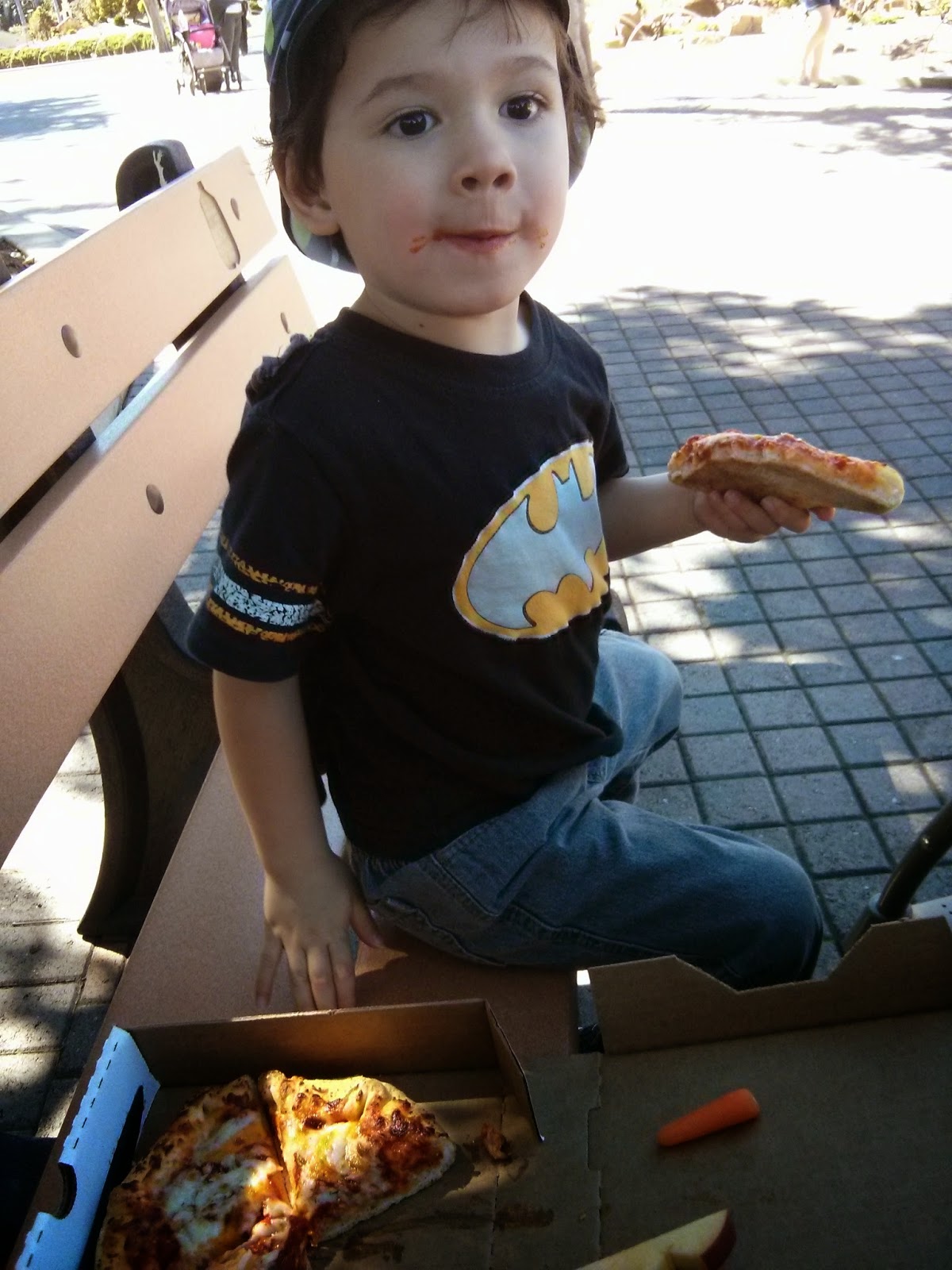 I might be wrong on this one. It could be lack of memory or experience on my part. But I love the food options at Legoland. There are several restaurants throughout the park, each with their own theme, providing many kid-friendly options that are also palatable for adults: pizza, salads and sandwiches, pasta, burgers, hot dogs, Asian, BBQ. Our favorite is Pizza Mania, where our oldest gets a personal pizza for lunch every day. (Oh, well, it's vacation, right?)
There are plenty of quiet, shady spots to eat. Our favorite is the patio behind The Garden. It's a great place to stop for an hour or two to let the baby nap in his stroller while we enjoy our food and the peace and quiet.
Of course the food is a little pricey but members get 20% off which makes it a lot more doable.
Also, while they say coolers and outside food aren't allowed, this is not enforced at all. On our last trip we brought bread, etc., from home, assembled sandwiches in our hotel room, and brought them to the park for the adults to eat, so we only had to buy food for the kids. That made a big difference, and also let me justify splurging on treats like apple fries and churros with chocolate sauce. Yum!
 4. Legoland is a Better Place to Play
The last time we went to Legoland, I think we went on a grand total of four rides during our three days at the park. Seriously. My son would rather play in one of the several play areas, his favorite being The Hideaways on Castle Hill, which is a giant three-story tree fort with several slides and climbing areas.
There is also a two-story play area in the Land of Adventure where kids can shoot foam balls through air-powered tubes, and Duplo Playtown, a big play area in Duplo Village that is great for toddlers and preschoolers.
 And, of course, everywhere you go there are Legos to build with. I especially love the Lego play areas strategically located in the waiting areas for rides. While parents stand in line, kiddos can build with Legos. Love it!
I don't remember any play areas at Disneyland. It's a great place for kids to passively consume entertainment, but at Legoland kids are actively engaged in creating their own "magic."
Which brings me to my last (but not least) point...
5. Legoland is More Educational than Disneyland
 This is something I'm especially sensitive to now that our oldest is in preschool. I'm always looking for teaching opportunities in daily life, and I love that Legoland is full of them. Beyond building with Legos, kids can learn how Legos are made at The Factory, practice driving at Driving School, test their creations at the Build & Test area, explore cause and effect by pushing buttons on the displays in Miniland, dig for fossils in Dino Island, see world landmarks on The Coast Cruise, and learn about fire safety at The Big Test show. There's even a Lego Mindstorms experience for older kids.
Maybe my memory is failing me, but I don't remember anything comparably educational at Disneyland. That's not necessarily a bad thing (everything doesn't have to be educational) but it's just one more thing I appreciate about Legoland.
I'm sure we will find ourselves at Disneyland again in the not-too-distant future. But for now we're getting good use out of our Legoland membership! It may not be "The Happiest Place on Earth" but it's my current happy place!
(And just in case you were wondering, Legoland didn't pay me to write this or anything. But people ask me all the time for my opinion about Legoland since they know we have gone a few times, so I figured I'd put it all in a blog post. :-)
 |
| Miniland at night is magical! |
And, of course, everywhere you go there are Legos to build with. I especially love the Lego play areas strategically located in the waiting areas for rides. While parents stand in line, kiddos can build with Legos. Love it!
Sure, we could (and do) play with Legos at home, but there's something about building with Legos at Legoland that sparks my four-year-old's creativity in a special way. Also they have giant foam bricks at Legoland which offer instant gratification as it takes only minutes to assemble a tower taller than a person, or a fort big enough for a little one! So rewarding.
(And just in case you were wondering, Legoland didn't pay me to write this or anything. But people ask me all the time for my opinion about Legoland since they know we have gone a few times, so I figured I'd put it all in a blog post. :-)
Saturday, February 21, 2015
What I Got from The Giver


While watching The Giver
recently I finally figured out why I love to read (some) dystopian fiction. It was quite a mystery to me for awhile, because while I love many kinds of books--historical fiction, sci-fi, children's lit, fantasy, YA, mysteries, non-fiction (pretty much anything)--I'm not big fan of violence, or less-than-happy endings, so why do I enjoy (some) dystopian fiction?
Because it makes me think. And I love a book (or movie) that makes me think. Especially when it helps clarify and express thoughts I'd already been thinking.
That's why I add the caveat some dystopian fiction. I really dislike dystopian fiction if it is gratuitously violent and lacks any redeeming philosophical quality, like, say, The Maze Runner. I kept reading after the first book because I thought I knew where the series was going, but by the third book it was clear I'd been wrong, though I did slog it out to the end for the sake of completion. Ugh. I wish I hadn't.
On the other hand, I really enjoyed reading The Giver several years ago (I think it was my first dystopian novel), and watching the movie recently reminded me why.
The Giver starts out with a seemingly perfect society, where no one suffers, there is no crime, all material needs are provided for, and really there are no questions or unknowns. It is organized, logical, chaos-free.
I was fascinated. Wouldn't we all love to live in a world with no suffering, no doubts, no needs?
Of course the truth eventually emerges--this seemingly perfect world is missing something very important: love. That is impossible to experience in a world where all choice has been eliminated so there is no chance that anyone will experience pain. Yes, the possibility for bad and hurtful choices has been removed, but so has the possibility for good and loving choices.
Without freedom there can be no real love.
Without love, life isn't really worth living.
Living without pain is not worth living without love.
Turn it around and you have the message that suffering is a necessary byproduct of love, because true love requires the freedom to choose, which also by necessity requires the freedom to choose to hurt.
 In other words, this secular dystopian novel articulates quite well the thoughts I have had in response to a question often asked of Christians: How can a good God let bad things happen?
It's a question I struggle with myself. I always seem to come back to the same conclusion: God could have made us robots who always choose to do the right thing. Then there would be no crime, no war. There would also be no love. And since love is one of God's defining characteristics, this would be an impossible state for creatures "made in his image."
He made us like him. Made us to love.
After all, the two greatest commandments, according to Jesus, are: "Love the Lord your God with all your heart, mind, and soul, and love your neighbor as yourself" (Matthew 22:37-39).
The fact that these are commandments implies the truth communicated in The Giver--we have a choice as to whether we will or will not love.
Unfortunately, many people choose to not love--God, or others, or even themselves. That option must be available to them or true love is impossible. And that is the source of pain in our world. People choose to hurt, betray, deceive, abandon, dominate, bully, harass, neglect...the list goes on and on.
So...that's it? We're stuck with this sucky world, doomed to endure the consequences of other people's choices as well as our own, and the consolation prize is that we are capable of love (though it often proves elusive, thanks to that dratted free will thing)?
No, that's not it. Thank God he didn't abandon us to this horrid hell of our own making. He knew what would happen when he made humans with this freedom to choose; he knew what we would choose. So before he even made the world, he made a plan to rescue us from the consequences of our own choices, taking the worst of it upon himself.
This is what differentiates the Christian message from any dystopian fiction that I have read--it gives us hope that we can have love AND no suffering, eventually, in Heaven.
I, for one, am looking forward to that!
recently I finally figured out why I love to read (some) dystopian fiction. It was quite a mystery to me for awhile, because while I love many kinds of books--historical fiction, sci-fi, children's lit, fantasy, YA, mysteries, non-fiction (pretty much anything)--I'm not big fan of violence, or less-than-happy endings, so why do I enjoy (some) dystopian fiction?
Subscribe to:
Posts (Atom)